Xin-Rong Li

(Ron Li)

I was born in 1993 and began learning to program with VB6 in 2008. I went on to use VB.NET, PHP, C/C++, Java, and JavaScript, and now primarily work with Rust and TypeScript. I specialize in developing websites, web services, specialized tools, and applications. I am also a heavy user of GNU/Linux and open-source software. GNU/Linux has been my primary operating system since 2010, when I was in my second year of high school. In 2014, I created magiclen.org to share my knowledge and experience, and have since written more than a thousand articles on a wide range of topics. Since 2018, I have also been actively contributing code to the global open-source community. My Rust crates on crates.io have long surpassed 100 million downloads in total.

Expe­rience

Webmaster of magiclen.org

magiclen.org
2014 – Present

Substitute Military Service at Taiwan Taoyuan International Airport

Aviation Police Bureau Security Agent
2015 – 2016

Webmaster of it-easy.tw

it-easy.tw
2008 – 2012

Education

National Taiwan University of Science and Technology

Bachelor's Degree, Computer Science & Information Engineering

Overall GPA is 3.89 / 4.00.

2011 – 2015

National Taichung Industrial High School

Department Of Computer Science
2008 – 2011

Certifi­cations

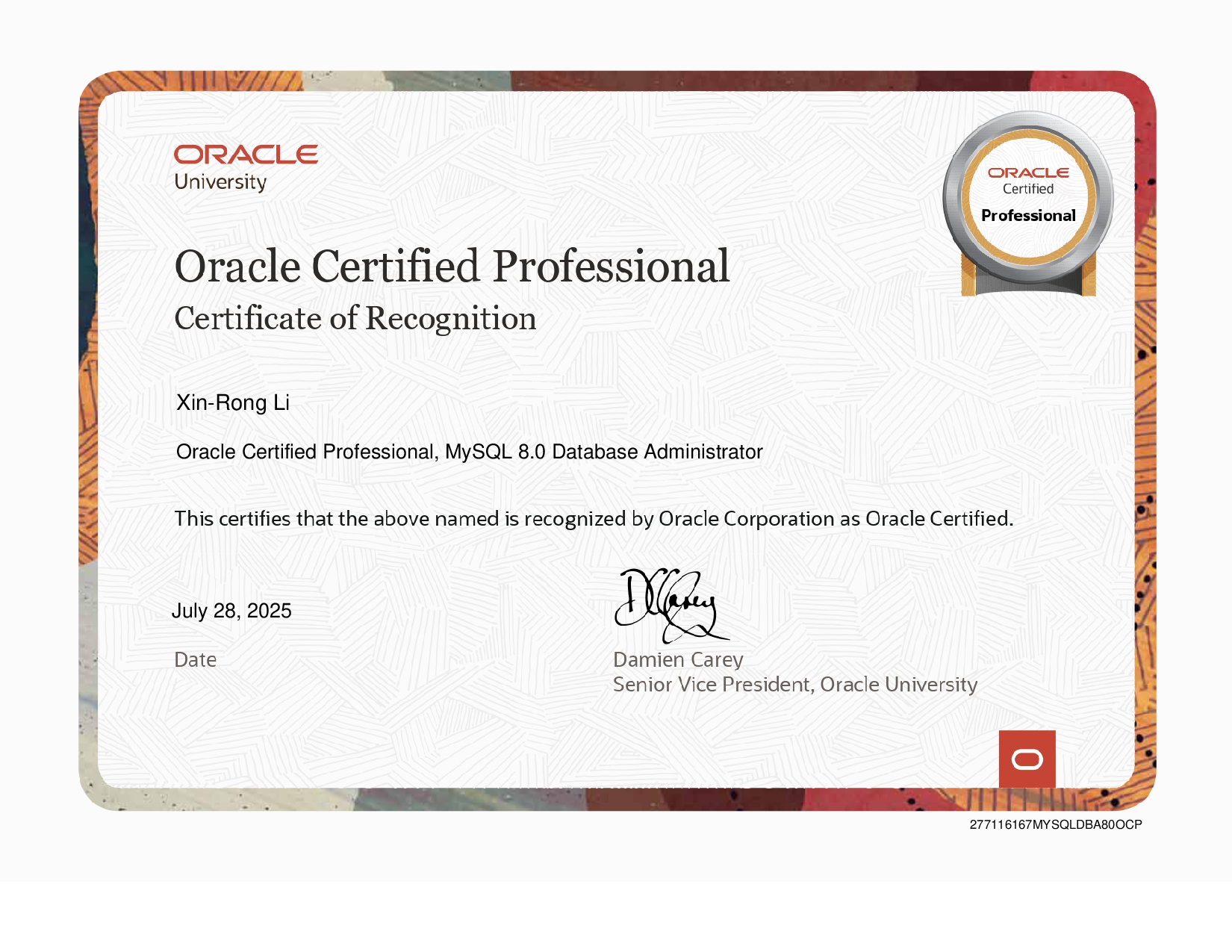
Oracle Certified Professional, MySQL 8.0 Database Administrator

Oracle
ID:
277116167MYSQLDBA80OCP

2025

Google Analytics Individual Qualification

Google
ID:
122555294
2022

TOEIC 860 (L: 445, R: 415)

Educational Testing Service (ETS)
ID:
19080039
2019

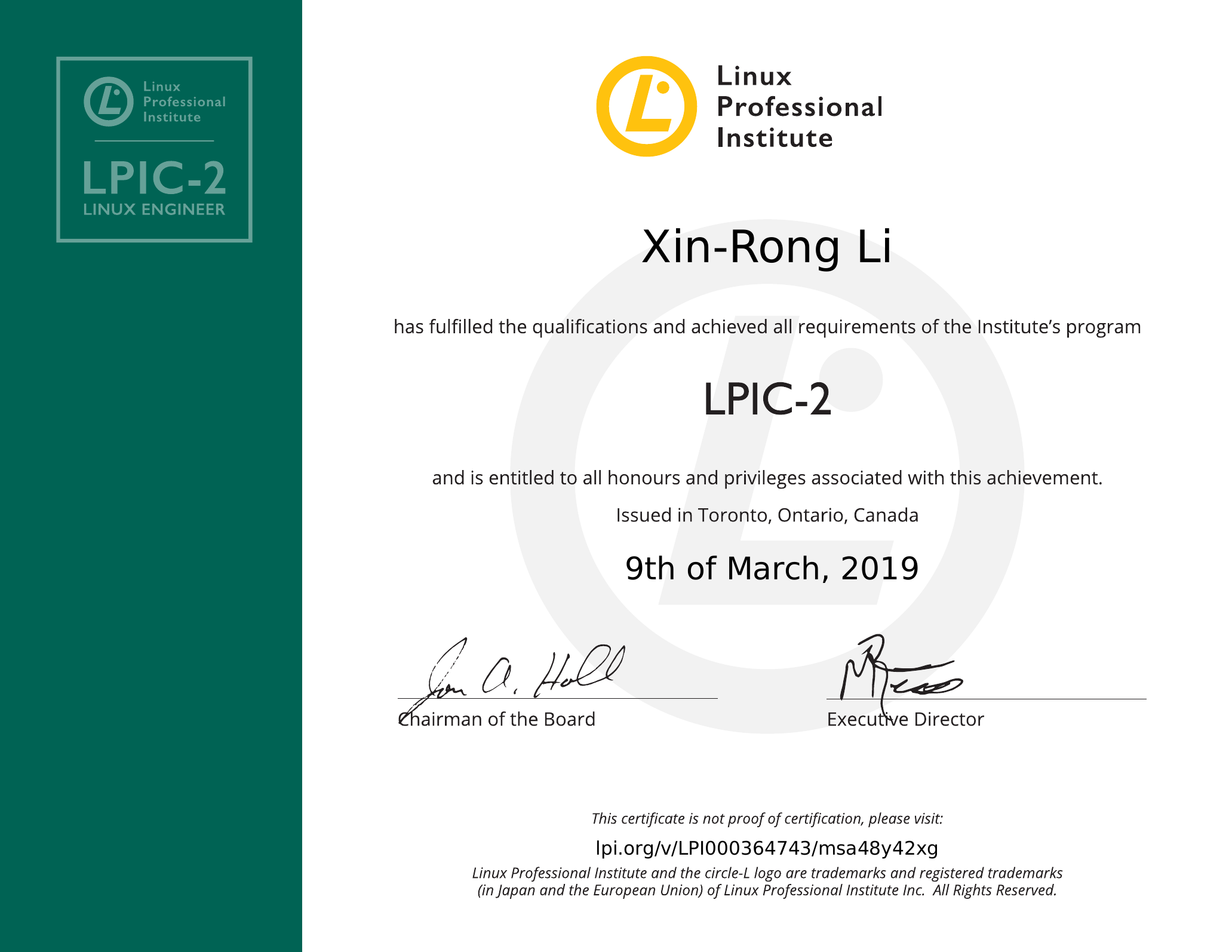
LPIC-2

Linux Professional Institute (LPI)
ID:
msa48y42xg

2019

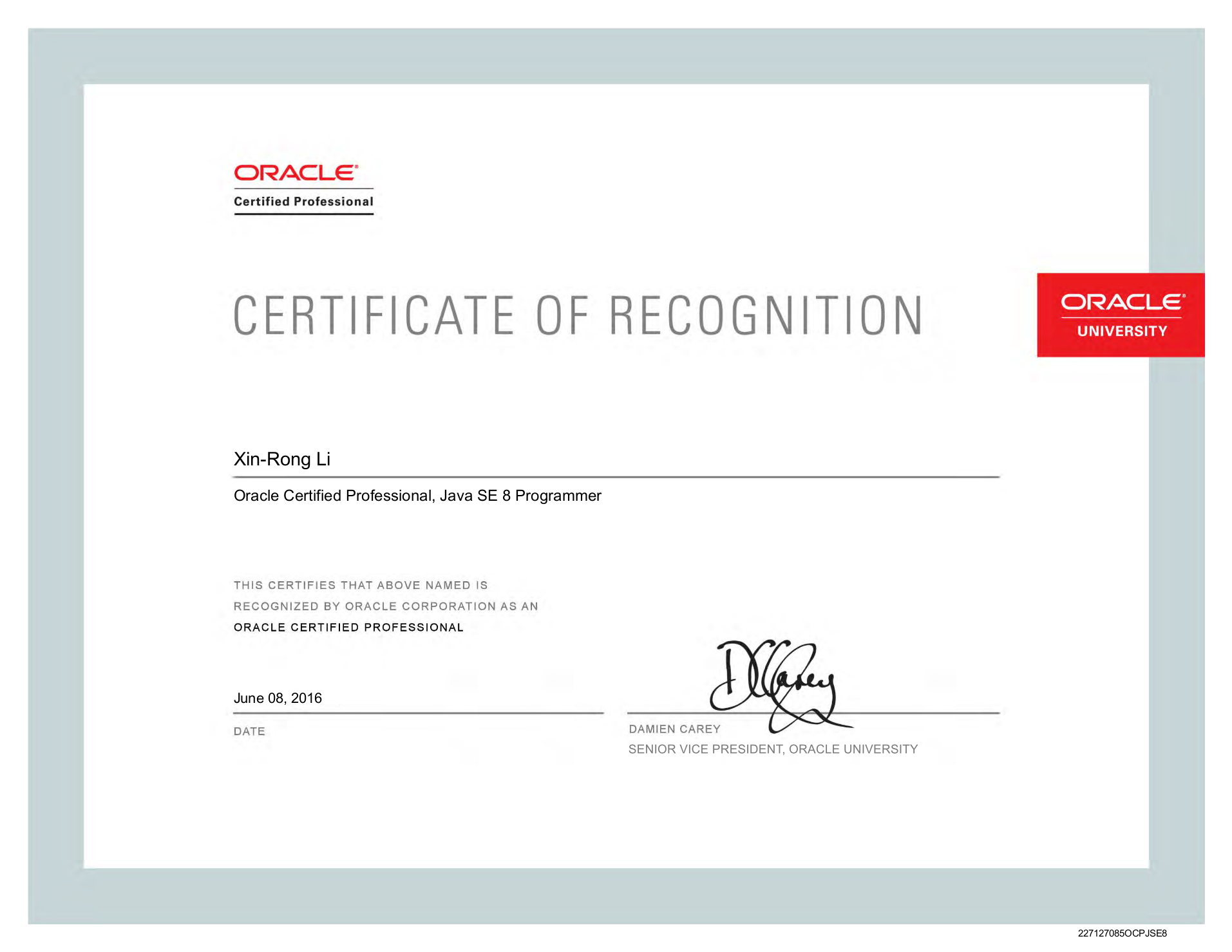
Oracle Certified Professional, Java SE 8 Programmer

Oracle
ID:
227127085OCPJSE8

2016

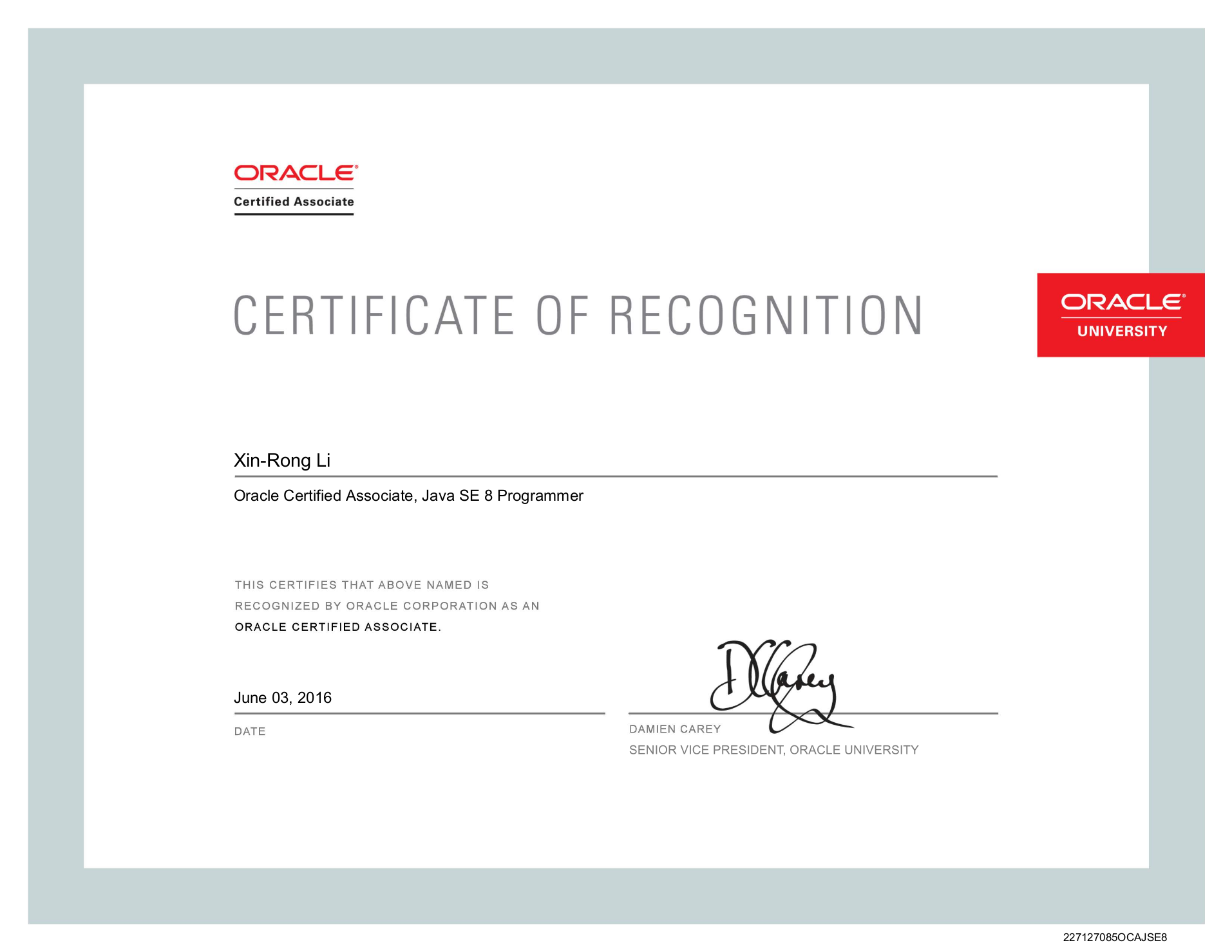
Oracle Certified Associate, Java SE 8 Programmer

Oracle
ID:
227127085OCAJSE8

2016

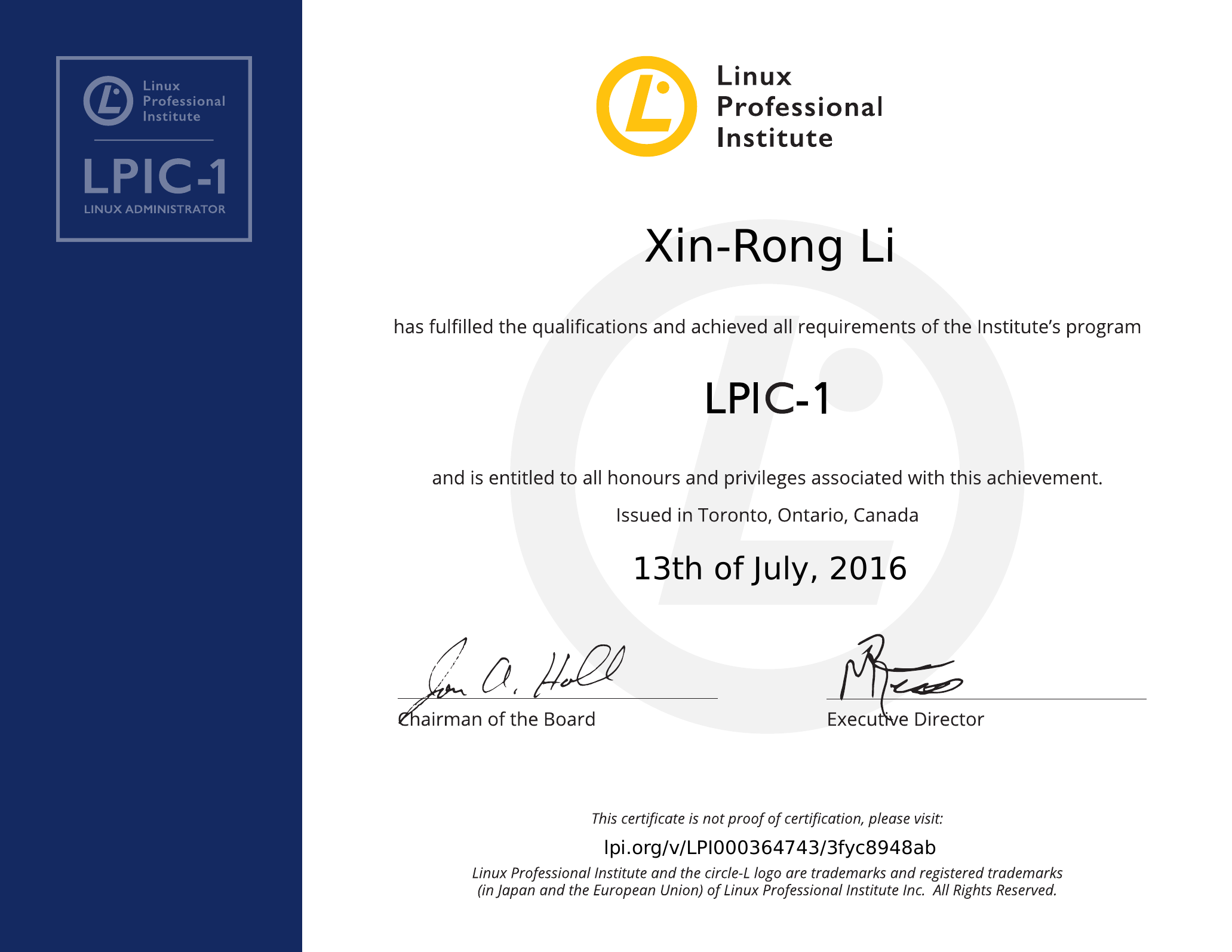
LPIC-1

Linux Professional Institute (LPI)
ID:
3fyc8948ab

2016

ITE Linux System Operation IT Expert

Computer Skills Foundation (CSF)
ID:
321160300000030
2016

TQC+ Java Programming Expert

Computer Skills Foundation (CSF)
ID:
111140600000
2014

Level B Technician for Computer Hardware Fabrication

Skill Evaluation Center of Workforce Development Agency
ID:
120-021063
2011

Level C Technician for Computer Hardware Fabrication

Skill Evaluation Center of Workforce Development Agency
ID:
120-173814
2010

GEPT (General English Proficiency Test) Elementary

The Language Training & Testing Center (LTTC)
ID:
E476009
2010

Level C Technician for Web Page Design

Skill Evaluation Center of Workforce Development Agency
ID:
173-103670
2009

Skills

Programming Languages

  • Experienced with: Rust, TypeScript/JavaScript
  • Familiar with: Java, C/C++, PHP, Golang, Bash

Operating Systems

  • GNU/Linux, Android

Web Frameworks & Libraries & Packages

  • PHP: WordPress, phpBB
  • Node.js: TypeScript, Webpack, Vite, NestJS, Fastify, Express
  • Rust: Rocket, axum, tonic
  • Front-end websites: Vue.js, React, Bootstrap, jQuery, Sass/SCSS
  • Web Servers: Nginx, Apache httpd
  • Container: Docker

Databases

  • SQL: PostgreSQL, MySQL, SQLite, SQL Server, Oracle
  • NoSQL: MongoDB, Redis

AI Coding Agent

  • Codex, Claude Code, GitHub Copilot

Natural Languages

  • Mandarin (native)
  • English (intermediate)

Other Skills

  • Computer hardware fabrication

Interests

  • Recitation of Chinese poems
  • Writing
  • Piano and digital music
  • Photographing
  • Jogging
  • Mountain climbing
  • Mathematics (developing...)

Personal Websites

Websites I actively maintain.

MagicLen

https://magiclen.org/

Articles on programming, software tools, and learning in everyday life.

Personal Apps

Apps I actively maintain.

Recitation Master

https://t.me/recitation_master_bot

A Telegram bot for practicing memorization. Upload your own question sets to practice poems, passages, or short-answer questions in sequential or random order, or take turns reciting lines with the bot.

Open Source Projects

alphanumeric-stepper

  • Rust100%
A reversible alphanumeric sequence codec for compact serial codes like 000..999, A00..Z99, AA0..ZZ9, and AAA..ZZZ.

axum-client-addr

  • Rust100%
Resolve client IP addresses in axum from trusted proxy headers with safe socket fallback.

duration-parts

  • Rust100%
A lightweight duration decomposition and formatting crate.

sliding-window-counter

  • Rust100%
A keyed sliding-window counter for tracking recent events per key.

time-of-day

  • Rust100%
A time-of-day type supporting the inclusive range from 00:00:00 through 24:00:00.

mssql-value-serializer

  • Rust100%
Convert Rust values into SQL Server-compatible literal expressions, enabling dynamic SQL generation without parameter count limitations.

rlock

  • Rust100%
An easy-to-use Redis-backed lock library providing both async and sync Mutex, RwLock, and others.

Datalith

  • Rust100%
A file management system powered by SQLite for metadata storage and the file system for file storage.

fetch-helper-x

  • JS100%
This package provides some useful utilities and functions for using the Fetch API.

grpc-js-helper

  • JS100%
Some useful items for playing with @grpc/grpc-js.

mininterval-runner

  • JS100%
Repeated execution with minimum interval control.

node-datalith

  • JS100%
A Node.js client for Datalith file storage, media processing, and HLS delivery.

rdb-pagination

  • Rust100%
SQL query extension library for handling pagination and sorting in relational databases.

adblock-checker

  • JS100%
Check if the current web browser has any ad blockers (AdBlock, Adblock Plus, uBlock, AdGuard, ...) enabled.

assert-eq-float

  • Rust100%
This crate provides the assert_eq_float! macros that support floats.

fit-html-text

  • JS100%
Fit text into its surrounding container.

input-time-helper

  • JS100%
Intuitively (by using local time) get/set the value of a date- or time-based HTML input element.

tw-nhi-icc

  • JS100%
Read Taiwan NHI cards in JavaScript/TypeScript.

tw-nhi-icc-service

  • Rust100%
Read Taiwan NHI cards via HTTP API.

date-differencer

  • Rust50.1%
  • JS49.9%
Calculate the time interval between two supported date-time values and output the result in years plus months plus days plus hours plus minutes plus seconds plus nanoseconds (instead of representing the same duration in different units). This library is useful for lifespan check and age calculation.

run-with-node-env

  • JS100%
Set the NODE_ENV variable on all platforms. Without cross-spawn, very slim.

tw-id-num

  • Rust50.1%
  • JS49.9%
Check or generate Taiwan ID numbers.

utf8-builder

  • Rust100%
Build and validate UTF-8 data from chunks. Each chunk doesn't have to be a complete UTF-8 data.

year-helper

  • Rust50.1%
  • JS49.9%
This library provides some useful functions to deal with years.

entity-tag

  • Rust100%
This crate provides a EntityTag structure and functions to deal with the ETag header field of HTTP.

gitlab-deploy

  • Rust100%
This tool is used for deploying software projects to multiple hosts during different phases.

manifest-dir-macros

  • Rust100%
This crate provides function-like macros to check or operate paths relative to CARGO_MANIFEST_DIR at compile time.

url-escape

  • Rust100%
This library is for encoding/escaping special characters in URLs and decoding/unescaping URLs as well.

Wait Service

  • Rust100%
Wait Service is a pure rust program to test and wait on the availability of multiple services.

word-dictionary

  • Rust100%
This crate provides a data structure for word mapping. It can be used for language translation.

concat-with

  • Rust100%
Extend the function of the concat! macro in std.

execute

  • Rust100%
A library for extending Command in order to execute programs more easily.

html-auto-p

  • Rust100%
This library provides a function like wpautop in Wordpress. It uses a group of regex replaces used to identify text formatted with newlines and replace double line-breaks with HTML paragraph tags.

html-escape

  • Rust100%
This library is for encoding/escaping special characters in HTML and decoding/unescaping HTML entities as well.

html-outliner

  • Rust100%
Outline HTML documents for better SEO.

Image Resizer

  • Rust100%
Resize or just shrink images and sharpen them appropriately.

lrc

  • Rust100%
A pure Rust implementation of LyRiCs which is a computer file format that synchronizes song lyrics with an audio file.

mprober-lib

  • Rust100%
A library aims to quickly collect Linux system information including hostname, kernel version, uptime, RTC time, load average, CPU, memory, pressure, sensors, batteries, cgroup limits, network interfaces, sockets, routes, block devices, mounts and processes.

Nginx Cache Purge

  • Rust100%
An alternative way to do proxy_cache_purge or fastcgi_cache_purge for Nginx.

paginator

  • Rust50.1%
  • JS49.9%
This crate is used for generating pagination bars.

rocket-jwt-authorization

  • Rust100%
This crate provides a procedural macro to create request guards used for authorization.

same-content

  • Rust100%
Determine whether data from different sources are the same.

sorted-insert

  • Rust100%
This crate provides traits to insert elements to a sorted collection and keep the order.

str-utils

  • Rust100%
This crate provides some traits to extend [u8], str and Cow<str>.

trim-in-place

  • Rust100%
In-place trimming strings.

unicode-blocks

  • Rust100%
This crate contains a list of all unicode blocks and provides some functions to search across them.

utf8-width

  • Rust100%
To determine the width of a UTF-8 character by providing its first byte.

words-count

  • Rust100%
Count the words and characters, with or without whitespaces.

benchmarking

  • Rust100%
This crate can be used to execute something and measure the execution time. It does not output anything to screens and filesystems.

boyer-moore-magiclen

  • Rust100%
Boyer-Moore-MagicLen, a fast string search algorithm implemented in Rust.

bulls-and-cows

  • Rust100%
A framework for building bulls-and-cows games (1A2B) for any data type.

cidr-utils

  • Rust100%
This crate provides functions for working with IPv4 CIDRs and IPv6 CIDRs.

debug-helper

  • Rust100%
This crate provides declarative macros to help you implement the Debug trait manually.

educe

  • Rust100%
This crate offers procedural macros designed to facilitate the swift implementation of Rust's built-in traits.

Image Interlacer

  • Rust100%
It helps you interlace an image or multiple images for web-page usage.

M Prober

  • Rust70%
  • JS30%
This program aims to collect Linux system information including hostname, kernel version, uptime, RTC time, load average, CPU, memory, network interfaces, block devices and processes. It can be used not only as a normal CLI tool, but also a web application with a front-end webpage and useful HTTP APIs.

rocket-include-tera

  • Rust100%
This is a crate which provides macros tera_resources_initialize! and tera_response! to statically include Tera files from your Rust project and make them be the HTTP response sources quickly.

rocket-recaptcha-v3

  • Rust100%
This crate can help you use reCAPTCHA v3 (v2 is backward compatible) in your Rocket web application.

scanner-rust

  • Rust100%
Simple text scanners which can parse primitive types and strings using UTF-8 or ASCII.

alphanumeric-sort

  • Rust100%
This crate can help you sort order for files and folders whose names contain numerals.

base64-stream

  • Rust100%
To encode/decode large data with the standard Base64 encoding.

base64-url

  • Rust100%
Base64 encode, decode, escape and unescape for URL applications.

bc

  • Rust100%
Use bc in the Rust Programming Language.

byte-unit

  • Rust100%
A library for interacting with units of bytes.

chinese-lunisolar-calendar

  • Rust100%
The traditional Chinese Calendar, known as 農曆 or 陰曆 in Chinese, is based on the moon, and is commonly referred to as the Lunar Calendar.

chinese-number

  • Rust100%
Convert primitive numbers to Chinese numbers, or parse Chinese numbers to primitive numbers.

chinese-variant

  • Rust100%
An enum to represent the variants of the Chinese Language.

crc-any

  • Rust100%
This crate computes CRC values from a bit width, a polynomial, a reflection setting, an initial value, and a final XOR value. It also provides many built-in CRC functions for common CRC variants.

enum-ordinalize

  • Rust100%
This library enables enums to not only obtain the ordinal values of their variants but also allows for the construction of enums from an ordinal value.

Favicon Generator

  • Rust100%
It helps you generate favicons with different formats and sizes.

FFmpeg Screen Recorder

  • Rust100%
This program is a gadget which helps you use FFmpeg to record your screen on Linux. The video record can be saved as a file, or be streamed via RTMP protocol.

html-minifier

  • Rust100%
This library minifies streaming HTML, including embedded JavaScript and CSS, while preserving pre and textarea content.

image-convert

  • Rust100%
A high level library for image identification, conversion, interlacing and high quality resizing.

json-gettext

  • Rust100%
A library for getting text from JSON usually for internationalization.

lazy-static-include

  • Rust100%
This crate provides lazy_static_include_bytes and lazy_static_include_str macros to replace include_bytes and include_str macros.

leveled-hash-map

  • Rust100%
A structure to separate values into different levels with keys. Every key-value entry which is not at the top level has a parent key at the superior level. Keys at the same level are unique, no matter what parent keys they have.

map-to-javascript-html

  • Rust100%
A library for serializing a map to JavaScript code in HTML usually for dynamically generating strings on web pages.

Markdown to HTML Converter

  • Rust100%
A tool for converting a Markdown file to a single HTML file with built-in CSS and JS.

mongo-file-center

  • Rust100%
To store perennial files and temporary files in MongoDB.

opencc-rust

  • Rust100%
Open Chinese Convert(OpenCC, 開放中文轉換) binding for the Rust language for conversion between Traditional Chinese and Simplified Chinese.

passwords

  • Rust100%
This crate provides useful tools to generate multiple readable passwords, as well as analyze and score them.

path-absolutize

  • Rust100%
A library for extending Path and PathBuf in order to get an absolute path and remove the containing dots.

path-dedot

  • Rust100%
A library for extending Path and PathBuf in order to parse the path which contains dots.

Pipe Logger

  • Rust100%
Stores, rotates, compresses process logs.

pipe-logger-lib

  • Rust100%
Stores, rotates, compresses process logs.

qrcode-generator

  • Rust100%
Generates ISO/IEC 18004 QR Code and Micro QR Code symbols and ISO/IEC 23941 rMQR symbols in pure Rust, then renders them as grayscale, PNG and SVG images.

rc-writer

  • Rust100%
A tiny implement for writing data to a reference counted instance.

rocket-accept-language

  • Rust100%
This crate provides a request guard used for getting accept-language header.

rocket-cache-response

  • Rust100%
This crate provides a response struct used for HTTP cache control.

rocket-client-addr

  • Rust100%
Resolve client IP addresses in rocket from trusted proxy headers with safe socket fallback.

rocket-download-response

  • Rust100%
This crate provides a response struct used for client downloading.

rocket-etag-if-none-match

  • Rust100%
This crate provides a request guard used for getting if-none-match header.

rocket-etagged-raw-response

  • Rust100%
This crate provides a response struct used for responding raw data with Etag cache.

rocket-include-handlebars

  • Rust100%
This is a crate which provides macros handlebars_resources_initialize! and handlebars_response! to statically include HBS (Handlebars) files from your Rust project and make them be the HTTP response sources quickly.

rocket-include-static-resources

  • Rust100%
This is a crate which provides macros static_resources_initializer! and static_response_handler! to statically include files from your Rust project and make them be the HTTP response sources quickly.

rocket-mongo-file-center-download-response

  • Rust100%
This crate provides a response struct used for client downloading from the File Center on MongoDB.

rocket-mongo-file-center-raw-response

  • Rust100%
This crate provides a response struct used for responding raw data from the File Center on MongoDB with Etag cache optionally.

rocket-multipart-form-data

  • Rust100%
This crate provides a multipart parser for the Rocket framework.

rocket-raw-response

  • Rust100%
This crate provides a response struct used for responding raw data.

s2tw

  • Rust100%
A simple tool for converting Simple Chinese to Traditional Chinese(TW).

ShortCrypt

  • Rust50.1%
  • JS49.9%
ShortCrypt is a very simple deterministic encryption library, which aims to encrypt any data into something random at first glance.

slash-formatter

  • Rust100%
This crate provides functions to deal with slashes and backslashes in strings.

synchronized-writer

  • Rust100%
A tiny implement for synchronously writing data.

tw2s

  • Rust100%
A simple tool for converting Traditional Chinese(TW) to Simple Chinese.

url-prefix

  • Rust100%
A library for creating URL prefix strings.

validators

  • Rust100%
This library is designed for validating and modeling user input. The crate includes models, functions, traits, errors, and other dependencies.

vcard

  • Rust100%
A pure Rust implementation of vCard 4.0 for generating and parsing vCards, based on RFC 6350 and RFC 9554.

XCompress

  • Rust100%
XCompress is a free file archiver utility on Linux, providing multi-format archiving to and extracting from ZIP, Z, GZIP, BZIP2, LZ, XZ, LZMA, 7ZIP, TAR, RAR and ZSTD.

zbar-rust

  • Rust100%
High-level and low-level ZBar binding for the Rust language.

node-crc

  • Rust60%
  • JS40%
To compute CRC values by providing the length of bits, expression, reflection, an initial value and a final xor value. It has many built-in CRC functions.

node-int32

  • JS60%
  • Rust40%
Use Rust to compute 32-bit signed integers and wrap around at the boundary.

node-int64

  • Rust90%
  • JS10%
Use Rust to compute 64-bit signed integers.

node-meminfo

  • Rust80%
  • JS20%
Get memory information on Linux.

node-qr-code

  • JS65%
  • Rust35%
Encode QR Code, Micro QR Code and rMQR symbols, and render them as SVG images, by using N-API.

node-sysconf

  • Rust75%
  • JS25%
Get configurable system variables.

MagicCrypt

  • Rust50.1%
  • JS49.9%
MagicCrypt is a Java/PHP/NodeJS/Rust library to encrypt/decrypt strings, files, or data, using Data Encryption Standard(DES) or Advanced Encryption Standard(AES) algorithms. It supports CBC block cipher mode, PKCS7 padding and 64, 128, 192 or 256-bits key length.

AI-Assisted Development

This is a record of how I adopted AI-assisted development. Model names mark different periods; they do not mean I used only that model at the time. The shares of AI-generated code are my approximate estimates of my own development work.

The GPT-3.5 period

When GPT-3.5 first appeared, I knew someone with limited programming fundamentals who used ChatGPT to write code. The output had obvious quality problems, but he did not recognize them and treated the model almost as an unquestionable authority.

I tried GPT-3.5 myself. Based on my experience at the time, it did not offer enough value for professional development. To me, it was mostly a toy to experiment with for occasional amusement.

The GPT-4o, o1, and o3 period

Models at this stage began helping me solve some problems in areas completely unfamiliar to me, and their practical value did improve. In programming, however, my years of development experience led me to judge their abilities as still far below what I could achieve myself. I therefore did not bring them into my coding workflow.

I also continued to see people trusting models too much, accepting answers without question even when they contained obvious errors. At the time, I strongly disagreed with gaining excessive confidence from AI without the ability to evaluate its output.

The GPT-5 period

GPT-5 did not immediately convince me. In my own use cases, it was even less effective than GPT-4o. There were also calls to keep using GPT-4o, which aligned with my experience. The new generation had not changed my reservations about using AI for software development.

The GPT-5.1 period

ChatGPT became noticeably more useful with GPT-5.1. Around this time, I began using it as I would Google Search: to find information, organize it quickly, and clarify problems.

It could occasionally solve somewhat challenging development problems, but its performance was still inconsistent, so I did not rely on it.

The GPT-5.2 / 5.3 period

Models at this stage could handle some work in programming languages unfamiliar to me, as well as write SQL scripts.

During the GPT-5.3 period, I also started using AI agent tools, primarily GitHub Copilot with Opus 4.6 from the same period, rather than only the GPT family. I still wrote most of the code myself. AI mainly helped scan it for obvious errors and handled a small amount of local implementation work.

AI-generated code share: approximately 5% or less

The GPT-5.4 period (March 2026)

I began delegating test writing and bug fixes directly to AI. Afterward, I still reviewed the generated code line by line.

By this stage, AI was already making a significant contribution to my software development.

AI-generated code share: approximately 30%

The GPT-5.5 period

I expanded AI involvement to requirements planning and implementation. I would first set a general direction to keep it from going too far off track, and I checked the resulting code.

AI-generated code share: approximately 80%

The GPT-5.6 period

By this stage, I rarely reviewed AI-generated code. I still set broad implementation guidelines, such as which package to use for a feature or which kind of algorithm to adopt.

AI-generated code share: approximately 95%

The GPT-6 period

During the GPT-6 period, I no longer review AI-generated code or specify packages and algorithms in advance. I only require work to be based on a designated project template so that CI/CD scripts and the basic toolchain remain broadly consistent.

My development process has shifted to expressing requirements in natural language and having AI carry out the implementation.

AI-generated code share: approximately 99%

My Perspective

In 2025, I still did not believe AI could replace professional software engineers. The progress after March 2026, during the GPT-5.4 period, changed my judgment. With a broader definition of the turning point, it could also be traced back to the GPT-5.2 period in December 2025.

Based on my own experience, AI has indeed substantially replaced the professional expertise of software engineers. By the GPT-6 period, I have been able to build software that satisfies me entirely through natural-language requirements, without reading any of the code. For example, non-technical teams at Coinbase have already used AI to write and ship production code. Designers at Ziroom in China have also built a home-design platform with Baidu Miaoda and put it into practical use.

I do not miss the days when I had to spend so much time coding. I consider having that time freed up a good thing. At the same time, I hope the high energy consumption of AI will not contribute to the continued deterioration of the Earth’s environment and ultimately threaten the survival of living things.